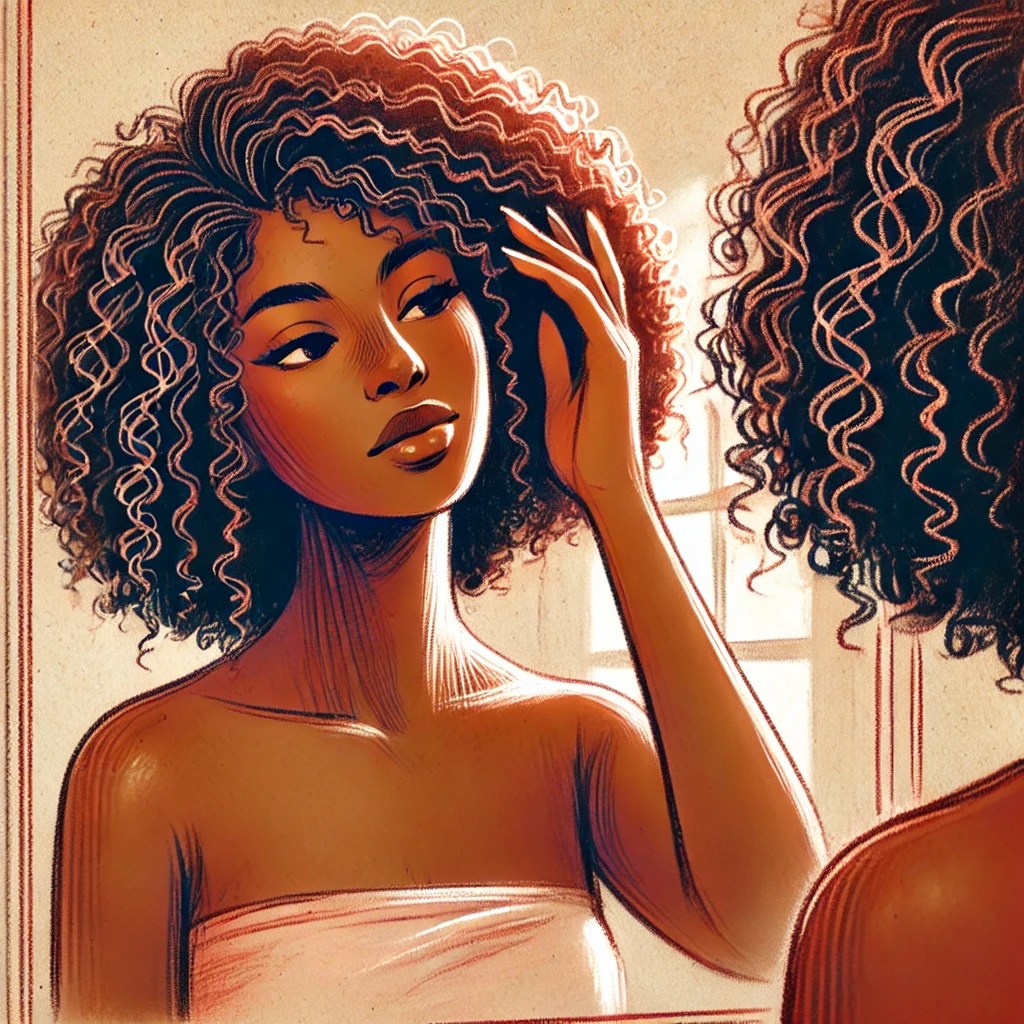
The night before last, I dreamed that my natural hair was growing in—thick, coily, and radiant. It was one of those close-up mirror dreams, where every curl at my roots shimmered with health. I was excited. I was showing my mom, smiling because I had just uncovered a part of myself I hadn’t seen in a while.
But in the dream, she didn’t smile back.
She gave a disgusted look at my hair and snapped, “Your hair doesn’t look good on you. I don’t know why you wearing it that way.”
I’ve never had that exact moment with my mother in real life, but it felt eerily familiar. In my waking life, I have known what it’s like to feel her disapproval when my hair wasn’t straightened. When it wasn’t polished into something she (and society) found acceptable.
The dream felt like my subconscious tapping me on the shoulder, whispering: There’s still something here.
And there is.
I am on my natural hair journey for the third time in so many years.
The first time, I didn’t know anything. I couldn’t properly wash my hair. I couldn’t detangle it. I could barely keep it moisturized. I was trying to love my hair without knowing how to care for it—a mirror of how I was trying to love myself: without the tools or support.
The second time, I got better at the care piece. Moisture. Scalp health. Researching the science of porosity and curl patterns. But I still struggled to style it in ways I felt were presentable and professional. I knew I needed a new stylist—someone who could help me with my natural coils—but I was scared. Scared to step outside my comfort zone. Scared to defy the voice of my late mother, who once told me not to “show all that nappy hair.”
Nappy.
It’s a word that still stings. A word that clings like residue. A word that has been used to shame tightly coiled, kinky 4C Black hair—like mine. I’m not sure when the word entered the Black American lexicon, but I know what it carries. Even now, I’m trying to reclaim it, the way some of us have reclaimed the N-word. Still, it doesn’t always sit right in my mouth.
Then came last December. My hair—and my body—were pushed to the brink.
I had a traumatic salon experience that I now see as a turning point. I suffered scalp burns after a relaxer touch-up at my former salon. The damage started before I even arrived. In a rush to remove glue from my first quick weave, I made the desperate decision to wash my hair less than two hours before the appointment. For 20 years, I never did that. I knew better. But I was tired. Frustrated. Trying to fix one mistake with another.
At the salon, my stylist asked if I wanted a wash and press or a touch-up. I chose the touch-up—one more time. Within two minutes, the chemicals started to burn. Not the mild tingle I’d once grown used to, but real pain. Alarm bells. I needed it rinsed out immediately.
And yet…I had to wait.
The stylist’s daughter was using the only available sink to wash another client’s hair. I sat there, writhing in pain, my scalp screaming. The memory reminds me of Denzel Washington’s character in Malcolm X, racing to the toilet as his head caught fire from the “creamy crack.” Only this wasn’t a movie. It was me. And no one rushed to help.
By the time the relaxer was rinsed out, I was traumatized. My stylist rubbed Neosporin on my scalp and told me she didn’t see any blood. I asked for a trim for my split ends, knowing deep down it would be the last time she ever touched my hair.
That night, yellow fluid wept from my scalp. It stained my pillowcase. I thought: This is what it’s come to? This is the cost of assimilation?
Luckily, I made it through. Four months later, my natural hair is growing in again. Healthy. Resilient. No signs of balding. Only a deeper understanding of what I’ve endured to finally start loving my coils.
So maybe that dream wasn’t about my mother at all.
Maybe it was about the version of me who is slowly, steadily learning to mother herself.
 Kee Grieves